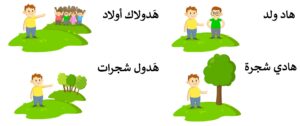
As in MSA, demonstrative pronouns in ‘Ammiyya agree with the nouns they refer to in gender and number in the singular form. The plural form refers to feminine, masculine, and mixed groups.
| English | الفصحى MSA |
العامية Colloquial Jordanian |
استَمِع Listen |
| This (m.) | هَذا | هاد | |
| This (f.) | هَذِهِ | هادي / هاي | |
| This (m./f.) / These | هَذا / هَذِهِ | هـَ + (الـ)اسم* | |
| These | هَؤُلاء | هَدول | |
| That (m.) | ذَلكَ | هَداك | |
| That (f.) | تِلْكَ | هَديك | |
| Those | أولَئِكَ | هَدولاك |
* Note that the demonstrative pronoun (هـَ) will only go with nouns that are defined with the / الـ.
Examples: Read and listen to the following sentences. Note the usage of demonstrative pronouns and their pronunciations in context:
| English | العامية Colloquial Jordanian |
استَمِع Listen |
| This instructor is from Jordan. | هاد الأُسْتاذ من الأردن. | |
| This is my sister’s car. | هاي سَيارة أُخْتي. | |
| I lived on this street one year ago. | سَكنِت في هالشارِع قَبِل سَنة. | |
| These are my books. | هَدول كُتْبي.* | |
| That is my uncle’s house. | هَداك بيت عَمّي. | |
| That school is new. | هديك المَدرَسة جديدة. | |
| Those girls are from Palestine. | هَدولاك البَنات مِن فِلِسْطين. |
* Unlike in MSA, where all non-human plurals are referred to with a feminine singular pronoun, in Jordanian Colloquial groups of objects can be referred to with either the feminine singular (هاي/هَديك) or plural (هَدول/هَدولاك) pronoun.
Now let’s practice!
Click to flip the cards and learn the demonstrative pronouns in ‘Ammiyya. Then, select a game to test your knowledge by clicking “Choose a Study Mode” on the bottom right corner. Have fun!
